WHEN DID SPORTS STOP BEING SPORTS?


A journey through the behavioral machine surrounding modern sports—and why the answer may change how you watch forever.
THE CURRENCY OF ATTENTION
There is a precise moment in every person's life when a story they believed was absolute transforms into something entirely different.
For some, it is the childhood realization about Santa Claus.
For others, it is the sudden clarity of how algorithmic advertising, social media platforms, or political campaigns actually operate behind the curtain.
The facts were always visible.
You simply had not yet been trained to recognize the architecture.
This article is not an attempt to prove that professional sports are fixed.
There is no publicly available evidence demonstrating that major professional sports leagues secretly coordinate game outcomes with sportsbooks.
A claim of that magnitude requires evidence.
Evidence matters.
Instead, this article examines a far more verifiable phenomenon.
It asks a different question:
When did sports stop being sports?
Not when athletes stopped competing.
Not when games stopped being real.
But when did the economic ecosystem surrounding sports evolve into something much larger than the competition itself?
When did sports become one of the most sophisticated behavioral-engagement systems ever assembled?
Because after studying sports betting markets, media partnerships, gambling psychology, behavioral economics, and the evolution of modern sports broadcasting, I became convinced of one thing:
The biggest transformation in sports did not happen on the field.
It happened around it.
THE NIGHT A 29-POINT LEAD LOST ITS VALUE
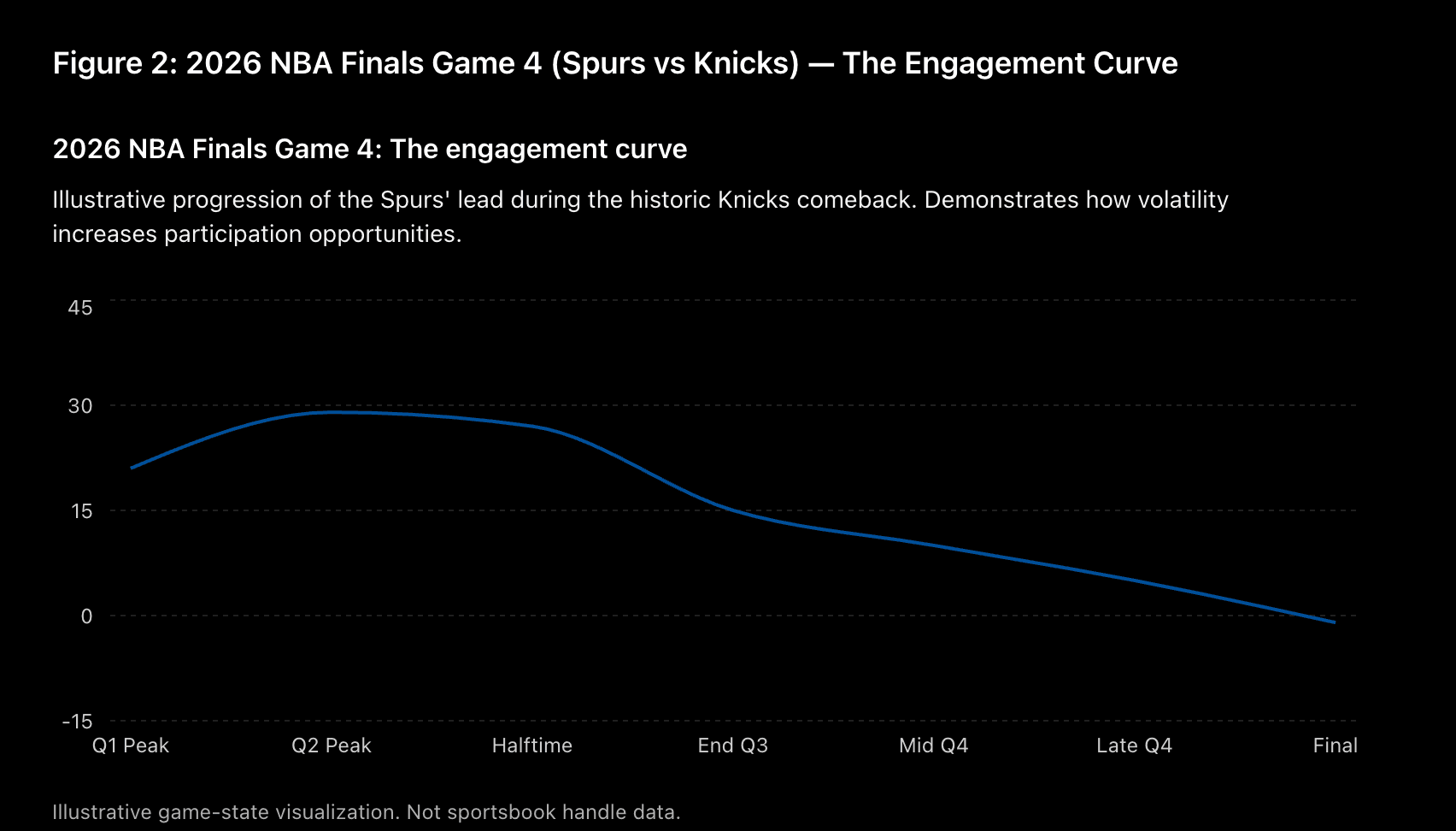
The 2026 NBA Finals provided a near-perfect illustration of the modern sports economy.
At one point during Game 4 between the San Antonio Spurs and New York Knicks, the Spurs built what appeared to be an insurmountable lead.
Historically, that should have ended the viewer experience.
The game should have become boring.
The audience should have declined.
Fans should have changed the channel.
Instead, millions remained engaged.
Why?
Because by 2026, the final score was no longer the only product being consumed.
The point spread was alive.
The over-under was alive.
The player props were alive.
The live betting markets were alive.
The Same-Game Parlays were alive.
Every possession still mattered.
Not just to basketball.
To the marketplace surrounding basketball.
The Knicks eventually completed one of the most dramatic Finals comebacks in modern memory.
To a sports fan, it was an unforgettable basketball game.
To the modern sports economy, it was something else.
It was an engagement masterpiece.
While the public watched the scoreboard, sportsbooks were watching something entirely different.
They were monitoring:
- Live wagering velocity
- Cash-out behavior
- Prop market exposure
- Session duration
- App activity
- Customer retention
Engagement metrics
The public saw basketball.
Sportsbooks saw behavioral data.
And that distinction matters.
Because it introduces a question most fans never consider:
What if the most valuable asset in sports is no longer the competition itself?
What if it is the monetizable attention generated by the competition?
THE SCOREBOARD YOU ARE NEVER ALLOWED TO SEE
After every major sporting event, fans ask the same questions.
Who made money?
Who lost money?
Which sportsbook won?
Which sportsbook got crushed?
The surprising reality is that the public almost never gets a complete answer.
Most fans assume sports betting operates with transparency similar to public stock exchanges or sports leagues.
It doesn't.
The public is permitted to see a carefully curated layer of information:
- The final score
- The opening line
- The closing line
- Odds movement
- Occasionally betting percentages
- Occasionally money percentages
But the dominant layer of information remains private.
Sportsbooks have access to:
- Total handle
- Real-time liability
- Customer profitability
- Live betting volume
- Customer behavior patterns
- Parlay exposure
- Cash-out activity
- Session duration
- Retention analytics
- Market-by-market risk exposure
The public generally does not.
Think about that for a moment.
Imagine attempting to trade stocks while only being allowed to see the ticker price.
You cannot see institutional order flow.
You cannot see hedge fund positioning.
You cannot see market-maker exposure.
You cannot see internal risk reports.
You cannot see customer profitability.
You only see the final price.
That is surprisingly similar to how the public experiences sports betting.
The public sees the game.
The sportsbooks see the game and the behavior surrounding the game.
This information asymmetry is not a conspiracy.
It is a business asset.
But throughout economic history, information asymmetry has consistently determined who holds the advantage.
The participant with the most complete dataset usually possesses the strongest mathematical position.
WHY THEY DON'T RELEASE THE DATA
Many readers immediately ask:
If sportsbooks have access to all this information, why don't they release it?
The answer is straightforward.
First, competitive advantage.
Customer behavior data has enormous value.
Risk-management data has enormous value.
Market exposure data has enormous value.
Detailed disclosures would reveal how sportsbooks manage liability, identify profitable customers, and generate revenue.
That information is commercially valuable.
Second, customer privacy.
Sportsbooks collect vast amounts of behavioral information.
Detailed disclosures could create obvious privacy concerns.
Third, reporting requirements.
Sportsbooks already disclose information required by regulators and investors.
They generally are not required to release detailed game-by-game profitability reports.
All of these explanations are legitimate.
But they also create an unavoidable reality.
One side of the transaction sees almost everything.
The other side sees very little.
That doesn't imply wrongdoing.
It simply means the sportsbook possesses dramatically more information than the customer.
And in every market throughout history, information has mattered.
Stocks.
Real estate.
Politics.
Technology.
Sports betting.
The people with the best information usually hold the greatest advantage.
THE PREMIUM ON UNCERTAINTY
Long before the 2026 NBA Finals, the blueprint for this phenomenon had already been established.
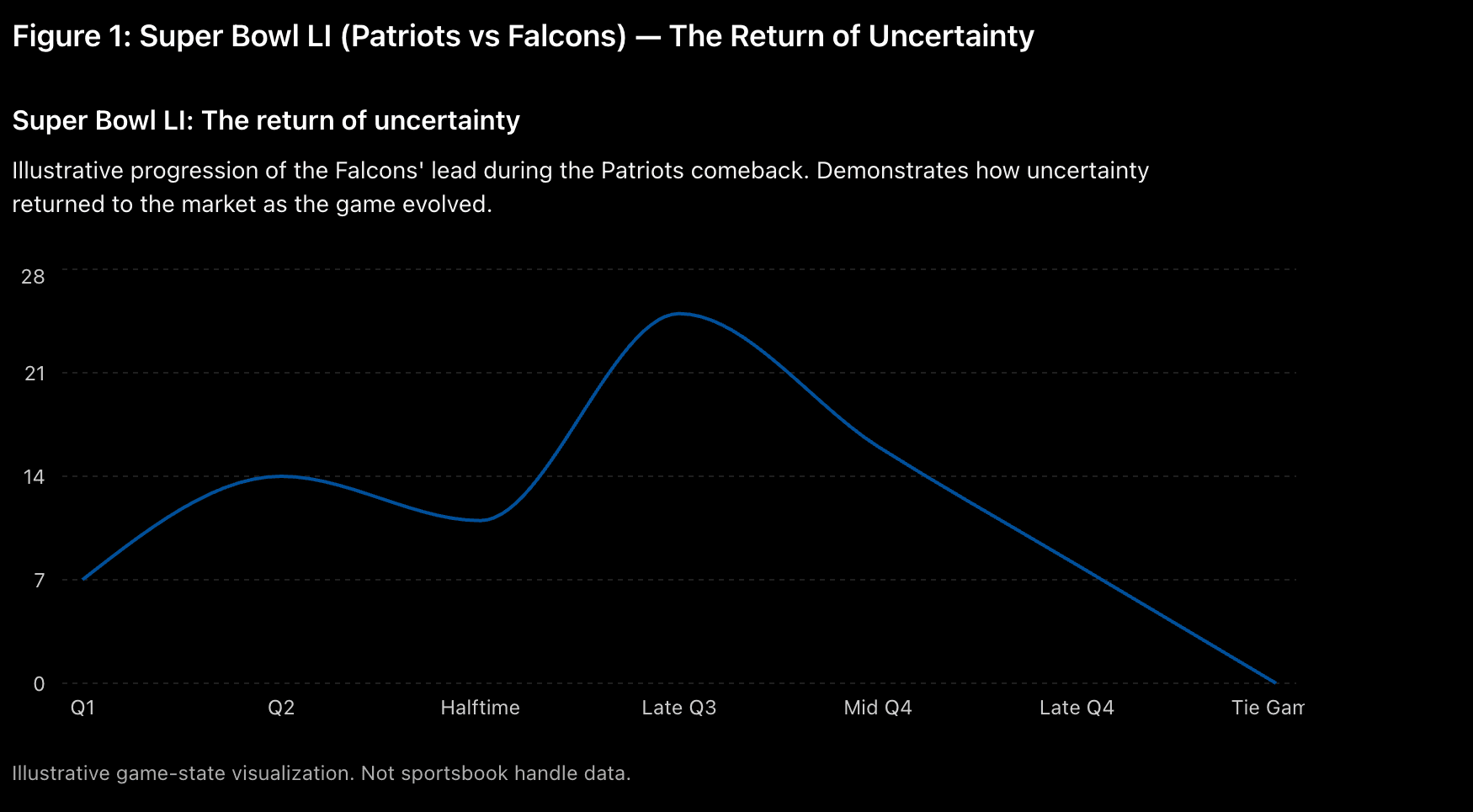
Super Bowl LI.
Patriots versus Falcons.
Atlanta led 28-3.
Millions believed the game was over.
From a competitive perspective, it nearly was.
Then the comeback began.
Every score changed the odds.
Every drive changed the probabilities.
Every possession changed the market.
The Patriots eventually completed the largest comeback in Super Bowl history.
The game became one of the most discussed sporting events ever played.
But from a betting perspective, something equally important happened.
The market never died.
It expanded.
As uncertainty returned, engagement increased.
As engagement increased, participation increased.
As participation increased, the market became more valuable.
The lesson isn't that the comeback was suspicious.
The lesson is that uncertainty itself possesses economic value.
The sports betting economy does not require a specific team to win.
It requires uncertainty to remain alive.
Variance resurrects it.
The system does not care who covers the spread.
The system benefits when the possibility of covering remains alive long enough to generate another interaction.
Another decision.
Another notification.
Another wager.
Another micro-transaction.
That isn't corruption.
It's behavioral economics.
WHAT BOTH COMEBACKS REVEAL
Spurs vs. Knicks.
Patriots vs. Falcons.
Different sports.
Different eras.
Different outcomes.
Yet both reveal the same fundamental truth.
The modern sports economy does not simply reward winners.
It rewards uncertainty.
It rewards volatility.
It rewards engagement.
A 29-point blowout kills engagement.
A dramatic comeback creates engagement.
A game that quietly ends is forgotten.
A game that remains uncertain becomes part of sports history.
Economics often explains behavior better than conspiracy theories.
And economics tells us something important:
Attention has become one of the most valuable commodities in the world.
The question is no longer whether sports generate attention.
The question is what happens when attention itself becomes the product.
GOODS QUESTION
What if future historians look back and conclude that the biggest transformation in sports wasn't athletic?
What if it was economic?
What if sports slowly evolved from a competition business into an engagement business?
What if the game became the delivery mechanism?
And the attention became the real currency?
That isn't a conclusion.
It's a question.
And before we can answer it, we need to understand how sports betting markets actually work.
Because most fans have no idea when the market opens, who creates the lines, who moves the lines, or who influences the prices they see every day.
And that story begins with an opening bell that almost nobody knows exists.
THE CASINO IN THE POCKET
Most Americans understand how the stock market works.
Every morning at 9:30 a.m. Eastern Time, the opening bell rings at the New York Stock Exchange.
The market opens.
Information enters the system.
Prices begin moving.
Investors react.
Algorithms react.
Institutions react.
Capital begins searching for opportunity.
Sports betting operates on a remarkably similar structure.
The difference is that most sports fans have no idea the market exists.
And once you understand how the market works, it becomes difficult to view sports betting the same way ever again.
THE OPENING BELL NOBODY TALKS ABOUT
Most fans believe betting begins on game day.
It doesn't.
The betting market often opens long before the game starts.
Sometimes days.
Sometimes weeks.
Sometimes months.
Super Bowl futures can be posted before the previous season has even ended.
Championship futures can be posted immediately after a title game concludes.
NFL weekly lines frequently appear within hours of the previous week's games ending.
NBA lines often appear the night before a game.
The moment a sportsbook publishes a number, the market officially opens.
That number becomes the starting point for price discovery.
Just like a stock.
Just like oil.
Just like gold.
Just like any other financial asset.
The sportsbook is not publishing a prediction.
It is publishing an opening price.
And from that moment forward, the market begins determining whether that price is correct.
THE FIRST MONEY ISN'T YOUR MONEY
One of the biggest misconceptions in sports betting is that sportsbooks create a line and then wait for casual fans to decide whether they agree.
That is not what happens.
The first people attacking a new betting line are usually not sports fans.
They are professionals.
They are syndicates.
They are quantitative analysts.
They are statistical modelers.
They are algorithms.
The moment a sportsbook posts a number, professional money begins searching for mistakes.
Imagine a sportsbook opens a game at:
Knicks -3.5
But a professional model evaluates the game as:
Knicks -5
Professional bettors immediately recognize value.
Money enters the market.
The sportsbook responds.
The line moves.
More information enters the market.
The line moves again.
The process repeats.
The public often believes they are participating in the creation of the market.
In reality, by the time most fans hear a television analyst discuss the spread, professional bettors may have already spent days correcting errors.
The market has already been shaped.
THE PEOPLE WHO MOVE THE MARKET
Most sports fans have never heard of the individuals who help shape betting markets.
Yet some of these individuals have influenced point spreads more than many coaches.
One of the most famous sports bettors in history is Billy Walters.
For decades, Walters built a reputation as one of the most successful sports bettors ever documented.
Sportsbooks closely monitored his activity because his wagers often signaled that a line might be incorrect.
Another famous example is Haralabos "Bob" Voulgaris.
Voulgaris became known for identifying inefficiencies in NBA betting markets through deep statistical analysis.
Rather than relying on intuition, he relied on data.
His approach looked less like traditional gambling and more like quantitative investing.
Then there are the syndicates.
Many remain private.
Most avoid publicity.
Some employ analysts, programmers, statisticians, and traders.
What appears to be sports betting from the outside often resembles financial engineering from the inside.
The public imagines fans making predictions.
The professionals are often building models.
THE DAY THE POINT SPREAD LOST ITS MYSTIQUE
Most fans believe the point spread predicts the final score.
It doesn't.
This may be one of the biggest misconceptions in sports.
The sportsbook begins by creating an opening number.
That number incorporates:
- Team strength
- Injuries
- Travel
- Rest
- Historical performance
- Matchups
- Weather
- Player availability
- Advanced analytics
But the opening number is only the beginning.
Once the market opens, participants begin reacting.
Professionals react.
Syndicates react.
Algorithms react.
The public reacts.
Information enters the system.
The line moves.
The final spread often becomes less of a prediction and more of a market consensus.
In other words:
The spread is not forecasting reality.
It is measuring collective belief.
That distinction changes everything.
Because the spread is not simply predicting the game.
It is revealing what the market thinks about the game.
THE SPORTSBOOK'S REAL JOB
Many fans believe sportsbooks are trying to predict winners.
That is only partially true.
The sportsbook's primary responsibility is risk management.
Think about a stock exchange.
Its job is not necessarily to determine what a company is worth.
Its job is to facilitate a market.
Sportsbooks operate similarly.
They create a number.
Then they monitor how the market responds.
The line becomes a conversation between:
- Oddsmakers
- Professional bettors
- Syndicates
- Algorithms
- Injury reports
- News
- Public perception
- Casual bettors
The final spread often reflects the market's collective opinion.
Not the sportsbook's opinion.
The sportsbook's true objective is not necessarily to be correct.
Its objective is to create an efficient market.
THE SECOND OPENING BELL
Most fans don't realize there is a second market opening.
It occurs at tip-off.
Or kickoff.
Or first pitch.
This is the live betting market.
And unlike traditional betting markets, the live market never closes until the game ends.
Every possession creates new prices.
Every injury creates new prices.
Every timeout creates new prices.
Every turnover creates new prices.
Every comeback creates new prices.
Every scoring run creates new prices.
The game becomes a continuously updating marketplace.
A financial market layered directly on top of athletic competition.
The 2026 NBA Finals illustrated this perfectly.
As the lead shrank from nearly thirty points to twenty.
Then fifteen.
Then ten.
Then five.
Then one.
The basketball game remained the same.
The market surrounding the game transformed repeatedly.
New opportunities emerged.
New risks emerged.
New decisions emerged.
The game wasn't simply being played.
It was being repriced.
Continuously.
THE INVENTION THAT CHANGED SPORTS FOREVER
Most people believe mobile betting changed sports.
It didn't.
The Same-Game Parlay changed sports.
The Same-Game Parlay transformed sports betting from a prediction business into an engagement business.
Traditional sports betting asks one question:
Who wins?
The Same-Game Parlay asks dozens.
Will the Spurs win?
Will Wembanyama score 30?
Will Brunson record 8 assists?
Will Castle hit three three-pointers?
Will the first quarter go over?
Will the Knicks score 105?
Will someone record a double-double?
Will someone score first?
One game.
Ten predictions.
One ticket.
One dream.
And significantly more ways to lose.
THE WEAPONIZATION OF THE PARLAY
For decades, casinos generated most of their reliable gambling revenue through slot machines.
Not blackjack.
Not poker.
Not roulette.
Slot machines.
Why?
Because slot machines maximize participation.
They maximize repetition.
They maximize volume.
Traditional sports betting could never replicate that model.
A bettor placed a wager.
Then waited.
Hours passed before a result arrived.
The system lacked velocity.
Then technology arrived.
And everything changed.
The Same-Game Parlay transformed one event into dozens of betting opportunities.
Every player became a market.
Every statistic became a market.
Every possession became a market.
Every game became a collection of interconnected possibilities.
Sportsbooks market this as customization.
And it genuinely is.
But economically it is also something else.
A dramatic increase in participation opportunities.
THE HARD MATH OF OPTIMISM
This is where the economics become fascinating.
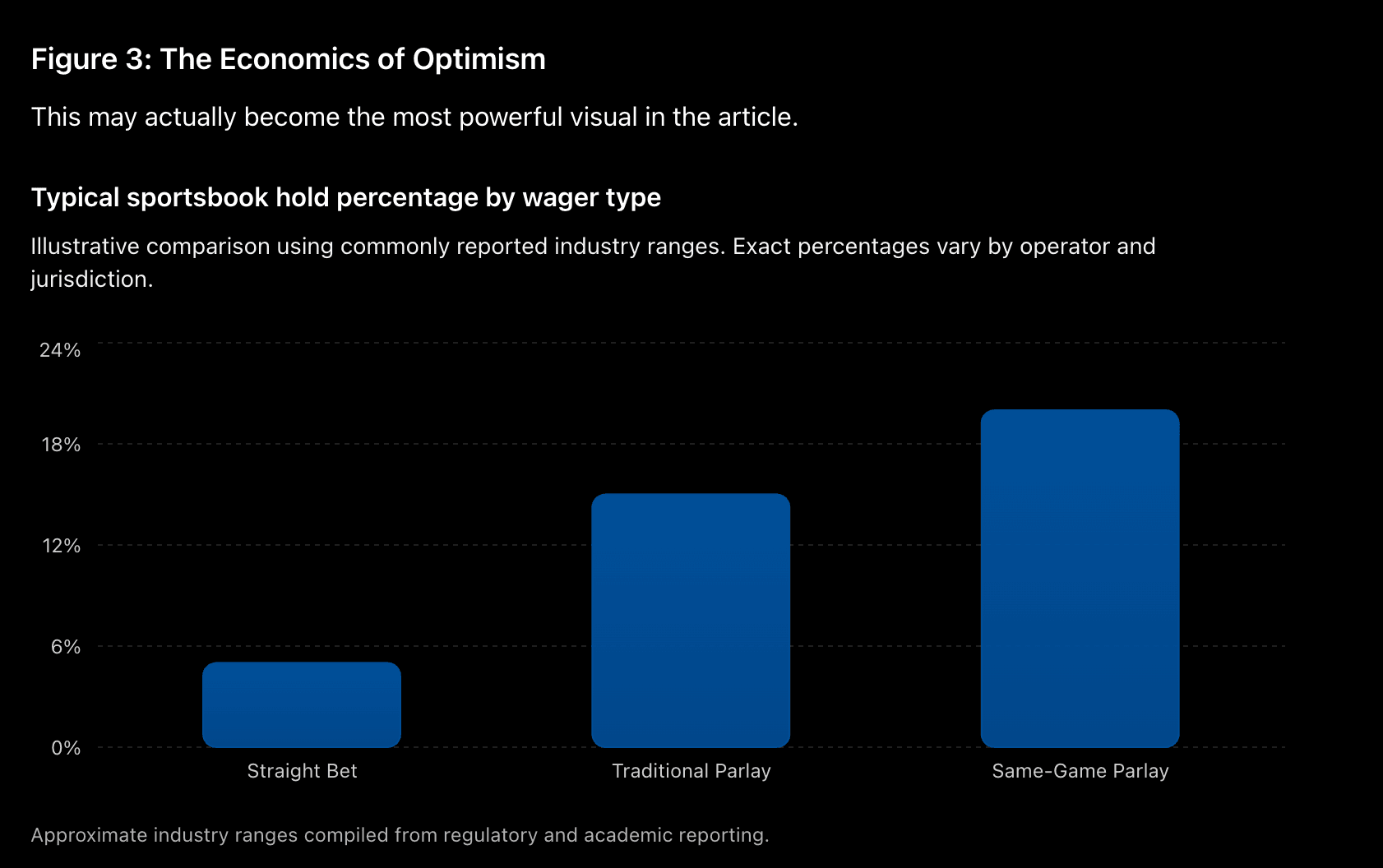
Traditional point spread betting historically produces relatively modest sportsbook hold percentages.
Parlays are different.
Industry disclosures repeatedly show that sportsbooks generate significantly larger hold percentages from parlay products than from traditional straight wagers.
The bettor sees possibility.
The sportsbook sees probability.
The bettor sees a life-changing payout.
The sportsbook sees compounding mathematical difficulty.
Both perspectives are accurate.
The customer feels more involved than ever.
The platform collects more participation than ever.
The result is one of the most profitable innovations in modern gambling.
THE DIGITAL SLOT MACHINE
Historically, sports betting looked very different.
One game.
One wager.
One result.
The modern model looks different.
One game.
Hundreds of possible wagers.
Thousands of possible outcomes.
Continuous engagement.
Continuous decision-making.
Continuous participation.
The customer feels more connected.
The platform gathers more behavioral data.
The experience becomes more interactive.
And the economics become dramatically more powerful.
What appears to be a sports product increasingly behaves like a technology product.
Because technology products monetize engagement.
And engagement is ultimately a behavioral phenomenon.
Which leads directly to the most important chapter in this entire story.
Because none of this works without understanding one thing:
Human psychology.
The modern sports betting ecosystem does not require consumers to lack sports knowledge.
It simply requires them to be human.
THE COGNITIVE TRAP
Human behavior.
Because the modern sports betting industry does not require its customers to be unintelligent.
It does not require them to be uninformed.
It does not require them to know nothing about sports.
It simply requires them to be human.
And humans have been remarkably predictable for thousands of years.
THE ILLUSION OF CONTROL
Behavioral scientists have spent decades studying how human beings make decisions under uncertainty.
One of the most researched concepts is called the Illusion of Control.
The principle is simple.
People frequently believe they possess more influence over uncertain outcomes than they actually do.
Sports fans are uniquely vulnerable to this phenomenon.
Think about what modern fandom looks like.
You know the roster.
You know the injuries.
You know the coaches.
You know the trends.
You know the advanced analytics.
You watched the last game.
You listened to the podcast.
You consumed the statistics.
You followed the social media accounts.
The more information you consume, the more confident you become.
The problem is that confidence and accuracy are not the same thing.
Knowledge can improve prediction.
But confidence tends to grow faster than predictive ability.
The modern bettor often mistakes familiarity with a sport for mastery of probability.
The sportsbook does not need to convince you that you know nothing.
The system benefits when you believe you know enough.
THE MOST PROFITABLE SENTENCE IN GAMBLING
There may be no more profitable sentence in commercial gambling than:
"I missed by one leg."
Think about what that statement actually means.
Not:
"I lost."
Not:
"I was wrong."
Not:
"I never had a chance."
Instead:
"I almost had it."
Behavioral researchers have repeatedly found that near misses create powerful psychological responses.
Missing an eight-leg parlay by one rebound feels dramatically different than missing all eight legs.
Financially, both outcomes are identical.
The money is gone.
Psychologically, they are worlds apart.
One feels like failure.
The other feels like progress.
And progress is addictive.
Because progress suggests success is close.
The bettor walks away believing:
"My analysis was right."
"I was one play away."
"I was one rebound away."
"I was one assist away."
The next wager becomes easier to justify.
And the next.
And the next.
And the next.
THE NEUROLOGY OF ALMOST WINNING
The human brain contains an interesting flaw.
Researchers studying reward pathways have found that near misses can activate some of the same neurological systems associated with actual rewards.
Not because the person won.
Because the brain interprets being close differently than being wrong.
The difference matters.
A complete failure discourages behavior.
A near miss often encourages repetition.
This is one reason gambling products emphasize what almost happened.
The story remains unfinished.
And unfinished stories tend to keep people engaged.
The customer experiences a loss.
The brain experiences possibility.
Those are not the same thing.
THE VARIABLE REWARD MACHINE
Psychologists have understood something important for decades:
Predictable rewards are less engaging than unpredictable rewards.
This principle appears everywhere.
Social media.
Video games.
Lottery tickets.
Slot machines.
Sports betting.
Humans are attracted to uncertainty.
The possibility of success often becomes more stimulating than success itself.
The anticipation becomes the reward.
Modern technology allows that anticipation to be delivered continuously.
Every score.
Every possession.
Every notification.
Every odds movement.
Every promotion.
Every wager.
The machine never truly stops.
THE DATA PIPELINE NOBODY TALKS ABOUT
Most fans assume live betting operates through oddsmakers manually adjusting lines.
That image is badly outdated.
Modern sports betting increasingly operates through a highly sophisticated data infrastructure.
Professional leagues now generate enormous revenue through official data partnerships.
Companies such as Sportradar and Genius Sports have secured major agreements to distribute official league data to sportsbooks around the world.
At the same time, tracking systems such as optical camera networks and player-tracking technology collect thousands of data points throughout games.
Player movement.
Ball movement.
Possession data.
Shot locations.
Velocity.
Distance traveled.
Reaction times.
Positioning.
The modern sporting event is no longer simply a competition.
It is also a real-time data generation engine.
And that data has value.
Lots of it.
THE LATENCY ADVANTAGE
Most fans assume everyone sees the game at the same time.
They don't.
Television broadcasts operate with delays.
Streaming broadcasts often operate with even larger delays.
Meanwhile, sportsbooks receive official data feeds at speeds measured in milliseconds.
That difference creates what traders refer to as latency.
Think about what that means.
When a viewer sees a free throw on television, the sportsbook may already have received multiple streams of information associated with that possession.
When a viewer sees a turnover, the pricing systems may have already begun recalculating probabilities.
When a viewer attempts to place a live wager, they are not competing against a human oddsmaker watching television.
They are interacting with a market connected to faster information.
This does not mean the market is unfair.
It means the market is technologically asymmetrical.
And throughout financial history, technological asymmetry has consistently created advantages.
The faster participant usually wins.
THE REVERSE STOCK MARKET
Now we arrive at one of the strangest realities in modern sports betting.
Imagine an investor develops a model that consistently beats the stock market.
What happens?
The investor becomes wealthy.
Now imagine a bettor develops a model that consistently beats sports betting markets.
What often happens?
The bettor gets restricted.
This is where many casual fans discover something surprising.
Sportsbooks do not simply evaluate wagers.
They evaluate customers.
Modern operators maintain sophisticated risk-management systems that profile betting behavior.
Accounts are evaluated based on factors such as:
- Betting patterns
- Market selection
- Closing-line performance
- Timing
- Profitability
- Promotional usage
- Risk exposure
Customers are not all viewed equally.
The industry often distinguishes between recreational bettors and professional bettors.
A recreational bettor may generate losses over time.
A professional bettor may generate liabilities.
Those two customers create very different business outcomes.
Professional bettors have documented practices commonly referred to as:
- Stake factoring
- Account limiting
- Wager restrictions
- Risk-based account management
In practical terms, this can mean a profitable bettor is allowed to wager dramatically less than a recreational bettor on the exact same market.
Think about that.
Two customers.
One market.
Two entirely different experiences.
The industry generally describes this as risk management.
And from a business perspective, that explanation makes sense.
But it creates a fascinating contradiction.
The industry spends billions of dollars advertising the possibility of winning.
Yet some of the people who win most consistently eventually become undesirable customers.
The message is:
Anyone can win.
The operational reality is:
Not every winner is equally welcome.
THE UNIFIED INCENTIVE STRUCTURE
Whenever you are trying to understand a system, ask one question:
Who benefits?
In the modern sports ecosystem:
Sportsbooks benefit when betting activity increases.
Media companies benefit when engagement increases.
Advertisers benefit when engagement increases.
Data companies benefit when engagement increases.
Technology platforms benefit when engagement increases.
Leagues benefit when engagement increases.
Different organizations.
Different products.
Different logos.
Different executives.
Yet many are ultimately measuring variations of the same metric:
Participation.
Engagement.
Attention.
Volume.
No major stakeholder benefits when consumers become less engaged.
No major stakeholder benefits when participation decreases.
No major stakeholder benefits when attention disappears.
That observation does not prove wrongdoing.
It reveals incentives.
And incentives often explain behavior better than intentions.
WHAT HISTORY ACTUALLY SHOWS
Whenever discussions about sports betting emerge, the conversation eventually reaches the same place:
"Are the games fixed?"
History provides an important answer.
Sports corruption exists.
It always has.
The public record contains:
- Point-shaving scandals
- Illegal bookmakers
- Insider information cases
- Gambling violations
- Match-fixing scandals
- Tim Donaghy
- College basketball scandals
- International soccer investigations
But history also reveals something else.
Most corruption emerges through individuals or small groups.
Not giant conspiracies involving thousands of people.
That pattern repeats across generations.
Which is exactly why modern integrity monitoring focuses on unusual activity rather than grand theories.
Investigators look for patterns.
Not rumors.
Evidence.
Not speculation.
Because evidence leaves footprints.
WHY THE FBI CARES
Many fans assume federal investigators became interested in sports betting because of conspiracy theories.
The reality is much simpler.
Trust is the product.
Without trust:
Leagues lose.
Sportsbooks lose.
Broadcasters lose.
Advertisers lose.
Sponsors lose.
Everyone loses.
The entire economic ecosystem depends on confidence.
That is why unusual betting activity receives scrutiny.
That is why integrity units exist.
That is why suspicious wagering reports are generated.
That is why betting markets are monitored.
Because confidence is valuable.
And confidence is fragile.
THE HARLEM GLOBETROTTER TEST
Now let's move into a thought experiment.
Not evidence.
Not allegations.
A thought experiment.
Imagine professional sports operated exactly like the Harlem Globetrotters.
Everyone knows the outcome beforehand.
Everyone understands the performance.
Everyone understands the entertainment.
What happens?
The betting market disappears.
The uncertainty disappears.
The economic value collapses.
Because uncertainty is the product.
Without uncertainty, there is no market.
Without uncertainty, there is no drama.
Without uncertainty, there is no reason to participate.
That observation reveals something important.
The sports ecosystem does not merely rely on competition.
It relies on confidence that competition remains uncertain.
And confidence is one of the most valuable assets in modern sports.
THE REAL QUESTION
For years, fans have asked:
"Are the games rigged?"
But what if that isn't the most important question?
What if the better question is:
What does the modern sports economy reward?
Does it reward competition?
Does it reward uncertainty?
Does it reward engagement?
Does it reward participation?
Does it reward betting activity?
Which moments create the most attention?
Which moments create the most interaction?
Which moments create the most transactions?
The public spends enormous amounts of time debating whether someone controls the outcome.
The more interesting question may be whether controlling the outcome is even necessary.
In an economy built on attention, engagement, participation, and behavioral data, the most valuable asset is not the final score.
It is the behavior generated before the final score arrives.
Maybe sports are exactly what they have always been.
Maybe they are not.
Maybe the biggest transformation in sports history happened around the game instead of inside it.
Maybe the most valuable thing in sports is no longer the competition itself.
Maybe it is the attention surrounding the competition.
Whether you still believe sports are just sports is a decision only you can make.
But if you've made it this far, one thing is probably true:
You're asking different questions than you were when you started.
And sometimes, that is where understanding begins.
You just got the goods from The Goods.