THE RAFTERS OF MEMORY


Why No. 14 Belongs Beside Indiana's Greatest Legends
One of the purposes of The Goods Virtual World is to revisit history and ask a simple question:
Who helped build the world we inherited but never received the full measure of recognition they earned?
Sometimes those people are inventors.
Sometimes they are educators.
Sometimes they are community leaders.
And sometimes they are athletes whose contributions became so deeply embedded into an institution that future generations stopped noticing them altogether.
That question led me to Freddie Lewis.
Not simply because of what he accomplished.
But because of what his story reveals about how institutions remember.
And sometimes forget.
The Difference Between Fame And Foundation
History tends to celebrate what is visible.
The game-winning shot.
The MVP trophy.
The headline.
The superstar.
But institutions are rarely built by visibility alone.
They are built by foundations.
The irony of foundations is that the stronger they become, the less people notice them.
Nobody walks into a cathedral and admires the concrete beneath it.
They admire the ceiling.
Yet without the foundation, there is no ceiling.
Without the builders, there is no monument.
Without the architects, there is no dynasty.
This is where the story of Freddie Lewis begins.
Before The Championships
Before there were banners hanging in Indiana, there was a young boy growing up in Huntington, West Virginia.
Long before professional basketball.
Long before sold-out arenas.
Long before championship celebrations.
There was simply a kid pursuing an opportunity.
That opportunity led him to Arizona State University, where he became one of the nation's premier guards before entering professional basketball during one of the sport's most transformative eras.
The ABA was not yet basketball's establishment.
It was basketball's challenger.
A league built by dreamers willing to bet on an uncertain future.
Freddie Lewis fit perfectly within that world.
He was never the loudest voice in the room.
Never the most celebrated personality.
Yet winning seemed to follow him everywhere he went.
Those kinds of people rarely dominate headlines.
But they often determine outcomes.
The Dynasty's Missing Pillar
The Indiana Pacers won ABA championships in 1970, 1972, and 1973.
Those championships are the foundation upon which the entire Pacers organization was built.
The banners exist because that dynasty existed.
The franchise's identity exists because that dynasty existed.
And Freddie Lewis was the only starting point guard who connected all three championship teams.
Think about that for a moment.
Three championships.
One point guard.
One floor leader.
One constant.
Freddie Lewis.
When basketball historians discuss dynasties, they often focus on scorers.
But dynasties are systems.
Every system requires someone capable of transforming talent into coordination.
Potential into execution.
Individuals into a team.
For Indiana, that person was Freddie Lewis.
He wasn't simply playing basketball.
He was organizing it.
Directing it.
Stabilizing it.
Making it work.
And when the Pacers captured the 1972 ABA Championship, it was Freddie Lewis who walked away with the ABA Playoff MVP Award.
Not Roger Brown.
Not Mel Daniels.
Not George McGinnis.
Freddie Lewis.
The man trusted with leading a championship run.
The Statistics Tell The Same Story
Some will argue that jersey retirements should be based on measurable accomplishments.
Fair enough.
Let's examine the measurements.
When Freddie Lewis left the ABA, he was the Indiana Pacers' all-time leader in:
• Games Played — 672
• Assists — 2,711
• Free Throws Made — 2,999
For years, he stood atop the franchise record book.
Not in one category.
In multiple foundational categories.
The categories that speak to reliability.
Availability.
Leadership.
Longevity.
And winning.
Beyond those franchise records, his résumé includes:
• Three ABA Championships
• ABA Playoff MVP
• Three ABA All-Star selections
• ABA All-Time Team selection
• Original Indiana Pacer
• Team Captain
• Member of the franchise's inaugural season
If retired jerseys are earned through contribution, achievement, longevity, and championship impact, then Freddie Lewis has already met the standard.
The numbers are not the argument.
They simply confirm it.
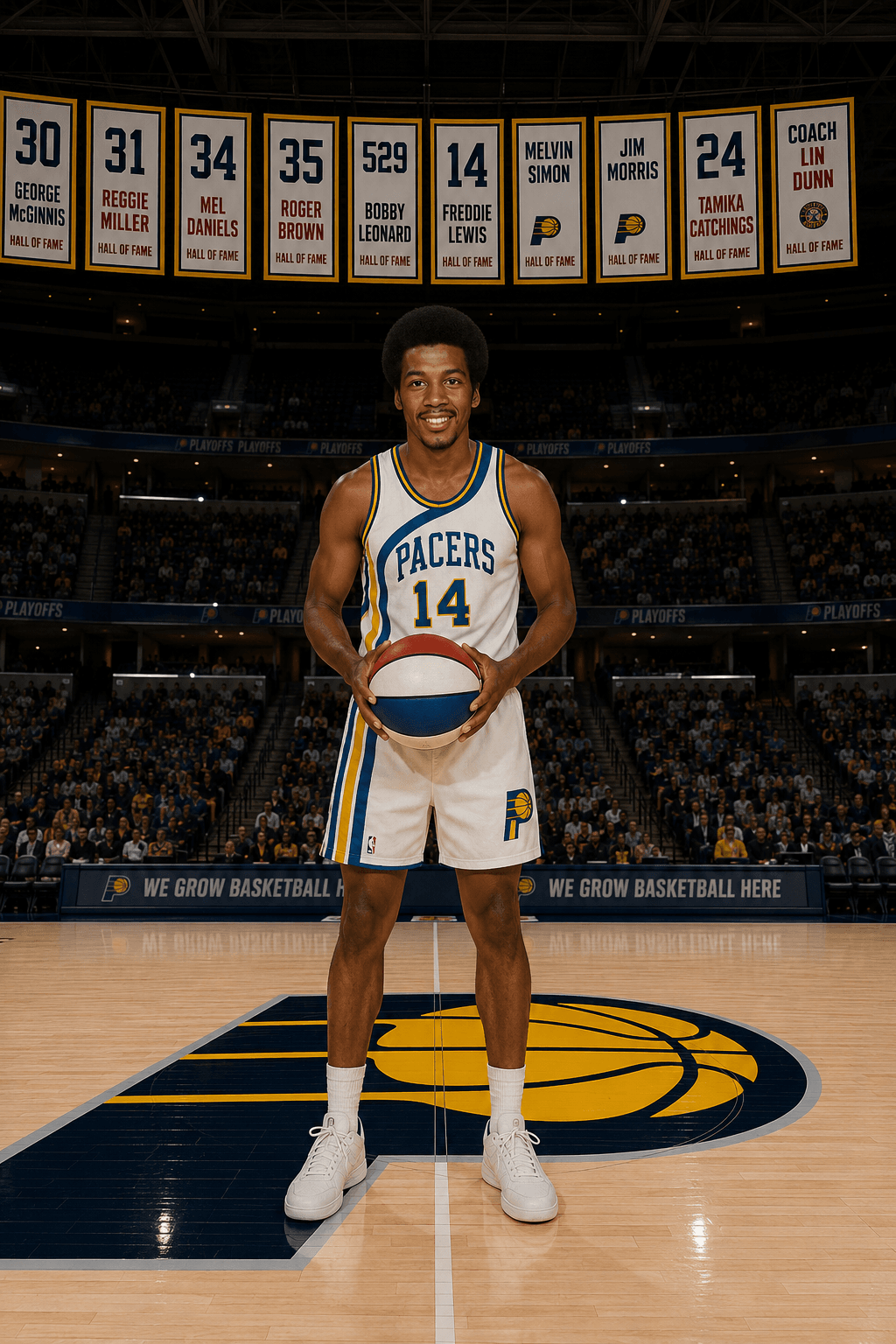
What Pacers Royalty Already Knows
Perhaps the most compelling part of this story is that this case is not new.
For years, former teammates, journalists, historians, and fans have openly advocated for Freddie Lewis' jersey retirement.
The people who built the dynasty understood his value better than anyone else because they lived it.
Hall of Fame teammates including Mel Daniels and George McGinnis publicly supported honoring Lewis during his lifetime.
Why?
Because championship teams understand something statistics alone cannot measure.
They understand dependence.
They know which player made everything function.
They know which player they trusted when the season was on the line.
The men who shared the court with Freddie Lewis have already cast their vote.
The question is whether history will eventually catch up.
Foundational Equity
There is a concept I believe every institution should consider.
I call it Foundational Equity.
Foundational Equity measures how much future success depends upon contributions made in the past.
Some individuals create results.
Others create conditions.
The people who create conditions often become the most undervalued people in history because their influence becomes invisible over time.
The building remains.
The builder disappears.
The culture remains.
The culture-maker disappears.
The institution remains.
The institution-builder disappears.
Freddie Lewis accumulated extraordinary Foundational Equity.
The Indiana Pacers fans know today were not built solely by championships.
They were built by the people who established what winning looked like in Indiana.
The people who created standards.
The people who created expectations.
The people who transformed an expansion franchise into a basketball institution.
Freddie Lewis was one of those people.
Not adjacent to the foundation.
Part of it.
The Measure Of A Life
The most compelling part of Freddie Lewis' story may not be what happened during his playing career.
It may be what happened afterward.
Because many athletes leave the game.
Freddie Lewis never truly left Indiana.
He remained connected to the community.
He remained accessible.
Present.
Visible.
A mentor to younger generations.
An ambassador for Indiana basketball.
A steward of the culture he helped create.
In a society increasingly obsessed with achievement, we sometimes overlook stewardship.
Achievement builds something.
Stewardship preserves it.
Freddie Lewis did both.
And that matters.
Because greatness is not measured solely by what a person accomplishes while the spotlight is shining.
It is measured by what they continue contributing after the spotlight moves elsewhere.
A Message To The Indiana Pacers
This is not criticism.
It is an invitation.
The Indiana Pacers have done an exceptional job preserving the legacy of the franchise's greatest figures.
Roger Brown's jersey hangs in the rafters.
Mel Daniels' jersey hangs in the rafters.
George McGinnis' jersey hangs in the rafters.
Reggie Miller's jersey hangs in the rafters.
Each deserves to be there.
But every dynasty has pillars.
And no historical account of Indiana's ABA dynasty can be complete without Freddie Lewis.
The rafters are not merely decorations.
They are a public memory system.
They tell future generations who mattered.
Who built.
Who sacrificed.
Who led.
Who made the institution possible.
The question is no longer whether Freddie Lewis deserves consideration.
The statistics support him.
The championships support him.
The historical record supports him.
His teammates support him.
The question is simpler than that.
Can the story of Indiana Pacers basketball truly be told in full while No. 14 remains absent?
I don't believe it can.
Because when future generations look upward, they should not simply see the stars.
They should see the foundation.
And when they look for the men who transformed a young franchise into a champion, they should find Freddie Lewis exactly where he belongs.
In the rafters.
Alongside the dynasty he helped build.
Freddie Lewis.
No. 14.
Forever.
You just got the goods from The Goods.