The House Has a Seat at the Table. The Bettor Should Too.


ONE SECOND.

On September 5, Michigan appeared to be seconds away from losing to Western Michigan.
Michigan trailed 12–7.
On an apparent final Hail Mary, the clock appeared to expire before the play was complete.
The game looked over.
Then officials reviewed the play.
One second returned to the clock.
Michigan received another snap.
This time, the Hail Mary landed.
Michigan won 13–12.
And almost immediately, the questions began.
What stopped the clock?
Why was one second restored?
What did replay show?
Who had authority to make the decision?
The Big Ten provided an explanation for the ruling and released replay material supporting its conclusion.
That matters.
I am not writing this to tell you the game was fixed.
I am not writing this to accuse officials of corruption.
And I am not writing this to tell you Michigan should have lost.
Financial exposure is not evidence of manipulation.
A controversial decision is not proof of conspiracy.
But the existence of legitimate explanations should not make legitimate questions inappropriate.

Because in modern sports, one second can change much more than a score.
It can change moneylines.
Spreads.
Parlays.
Live bets.
Sportsbook liabilities.
Bettor payouts.
And thousands of financial decisions attached to a game.
That realization made me stop asking whether the call was right.
I started asking a different question.
Who represents the bettor?
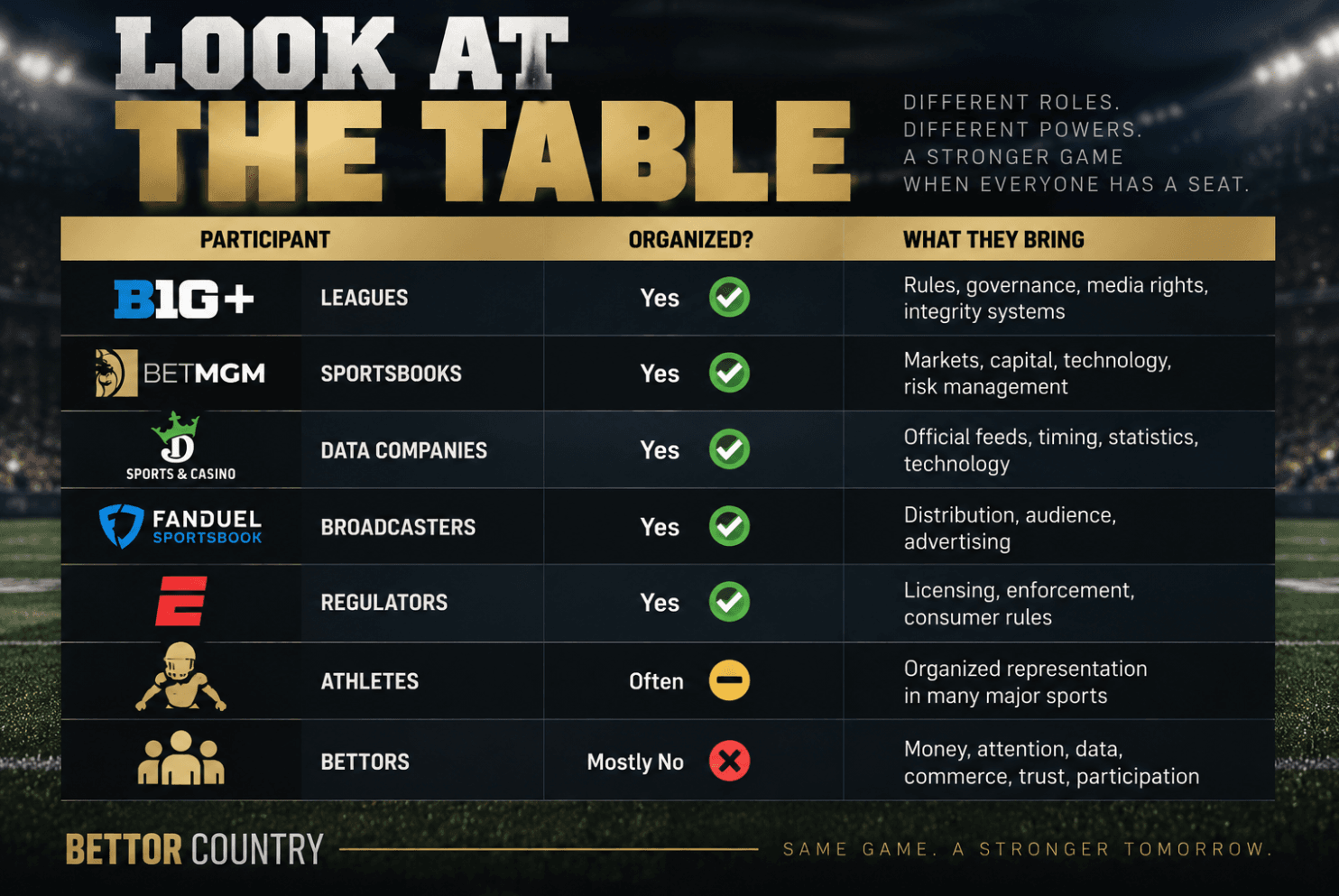
Every major participant arrives with an institution behind them.
The bettor usually arrives with a username, a terms-of-service agreement, and customer support.
One bettor.
One account.
One wager.
Once I saw that imbalance, I could not stop seeing it.

WHY NOW?
Sports betting is no longer sitting quietly beside sports culture.
It is inside broadcasts.
Inside phones.
Inside stadiums.
Inside advertising.
Inside fantasy sports.
Inside group chats.
Inside the way millions of people experience games.
The economic relationship grew faster than the bettor's ability to understand, influence, or negotiate its terms.
That does not require anger.
It requires an institution.
So I started imagining one.
Bettor Country.
WHAT IS BETTOR COUNTRY?
Bettor Country is a proposed independent home of the bettor.
A member-governed institution built around one simple principle:
Our participation belongs to us.
The sportsbook owns its product.
The league governs its competition.
The broadcaster controls its distribution.
The regulator exercises its lawful authority.
The bettor decides whether to participate.
Bettor Country organizes that last piece.
Not by taking away individual choice.
By giving individual choice institutional standing.
One bettor is a customer.
Millions of organized bettors become a constituency.

WHAT THIS IS NOT
Bettor Country is not a sportsbook.
It is not a picks service.
It is not an affiliate funnel disguised as advocacy.
It is not a conspiracy network.
It is not a promise that bettors should win every dispute.
It is not a replacement for regulators.
It is not a mechanism for coordinating wagers.
And it is not a campaign to destroy the sports-betting industry.
In fact, the idea begins from the opposite position.
There does not need to be a war.
Sportsbooks should build extraordinary businesses.
Leagues should protect their games.
Broadcasters should create great coverage.
Technology companies should innovate.
Regulators should protect the public.
And bettors should remain free to participate.
The problem is not that these institutions became powerful.
The question is what happens when the people across the table become organized too.
SO WHAT WOULD BETTOR COUNTRY ACTUALLY DO?
It should start by being useful.
Before influence.
Before partnerships.
Before bargaining power.
Before millions of members.
Help somebody.
That begins with:
THE BETTOR ADVOCATE.
Imagine waking up after a game and discovering that your wager was graded differently than expected.
You read the rules.
You contact support.
You have screenshots.
You have messages.
You think something is wrong.
Maybe you are right.
Maybe you are not.
Where do you go?
The Bettor Advocate would help people understand published rules, organize evidence, construct timelines, and identify appropriate escalation channels.
Not with outrage.
With the rule.
The record.
The timeline.
The evidence.
Sometimes the evidence will support the bettor.
Sometimes it will support the operator.
Our obligation is not to manufacture victories.
Our obligation is to pursue clarity.
THEN BUILD THE COURT
A single bettor may have screenshots.
A thousand bettors may have a pattern.
That is the difference between a complaint and evidence.
The Bettor Court would begin as structured consumer casework, evidence organization, pattern analysis, and escalation support.
It would not pretend to be a government court.
It would not replace regulators.
It would not guarantee that the bettor wins.
The promise would be simpler:
The bettor should have a meaningful path to be heard.
THEN BUILD THE LEDGER
Sportsbooks know what customers are worth.
They study acquisition cost.
Retention.
Engagement.
Deposits.
Product preferences.
Lifetime value.
Bettors should become equally serious about understanding the other side of that equation.
Because a bettor contributes more to the sports economy than a wager.
Viewing.
Streaming.
Tickets.
Travel.
Merchandise.
Subscriptions.
Advertising attention.
Digital engagement.
Data.
And wagering.
The Ledger would attempt to measure that footprint.
Not to manufacture a giant number.
To answer a question:
What is our participation actually worth?
It is difficult to negotiate your value when you have never calculated it.
AND EVENTUALLY, OPEN THE WINDOW
This is where Bettor Country becomes more ambitious.
Imagine something called:
THE SCRIPT.
No, not tomorrow's winner.
Not proof that games are predetermined.
Not inside information.
Not locker-room strategy.
A window into the institutional process surrounding the wager.
When something extraordinary happens:
What rule applied?
Who had authority?
What triggered the review?
What official data was used?
Why was time restored?
Why was a statistic changed?
Why was a wager resettled?
What can responsibly be explained?
We should not know who wins tomorrow.
That uncertainty is part of what makes sports worth watching.
But when something extraordinary happens today, asking for a better explanation tomorrow should not be considered hostile.

We are not asking to know tomorrow's winner. We are asking for a better ability to understand yesterday's decision.
And as Bettor Country grows, that principle could eventually support much more:
portable membership,
independent dispute systems,
a marketplace where companies compete to earn bettor preference,
formal bettor representation,
and stronger evidence standards for extraordinary wager-material decisions.
Those ideas have names.
The Passport.
The Exchange.
The Black Box.
The Room.
But we do not need to build the country in a day.
First, we need to prove the foundation works.
THE RULE THAT CANNOT CHANGE
There is one question I believe Bettor Country should ask before approving any product, sponsor, partnership, metric, or revenue stream:
Would this still help the citizen if that person never placed another wager?
If the answer is no, we should examine what we are really building.
A citizen who takes a break should still matter.
A citizen who stops wagering should still matter.
A citizen using self-exclusion should still matter.
Someone should not become less valuable to Bettor Country because they stopped generating gambling revenue.
That means Bettor Country cannot build itself around compensation that increases because its citizens wager more or lose more.
Otherwise, eventually, we become another organization that needs the bettor's gambling activity more than it needs the bettor.
That cannot be the model.
WHY SHOULD YOU TRUST BETTOR COUNTRY?
You shouldn't.
Not yet.
Trust should be earned.
So every year, Bettor Country should have to produce:
THE FIVE PROOFS.
PROOF OF INDEPENDENCE
Who funded us?
Did any revenue depend upon citizens wagering or losing more?
PROOF OF DEMOCRACY
Who actually controlled the institution?
Could money buy additional political influence?
PROOF OF SERVICE
How many people did we actually help?
PROOF OF TRUTH
How often did evidence support bettors?
How often did it support operators?
What did we get wrong?
PROOF OF PROGRESS
And finally:
What became better?
Were rules clearer?
Were disputes resolved faster?
Did privacy improve?
Did people receive better information?
Did an operator receive independent confirmation that it acted correctly?
Did someone receive help before gambling caused greater harm?
Did bettors gain meaningful representation?
Not how loud did we become.
Not how many followers did we collect.
Not how much money did we raise.
What became better because Bettor Country existed?
Publish the answer.
Then go back to work.
A COUNTERWEIGHT
There will never be perfect balance.
There probably should not be.
Different participants bring different resources.
Different responsibilities require different authority.
Different risks deserve different rewards.
Balance does not mean sameness.
The scale matters when one side becomes so institutionally heavy that the other can no longer meaningfully participate in the relationship.
Then there are choices.
Ignore it.
Wait for resentment.
Wait for distrust.
Wait until everyone decides someone must become the enemy.
Or introduce a counterweight.
That is what Bettor Country intends to become.
Not the new house.
Not the enemy of the house.
A counterweight.
THIS IS THE INVITATION
Bettor Country does not exist today in the form described here.
It has to be built.
And I do not think its first members should join because they want another promotion.
Or another betting community.
Or another person selling picks.
Join because you believe the bettor deserves standing.
Join because you believe questions deserve evidence.
Join because you believe an institution representing bettors should be able to tell a bettor when the sportsbook is right.
Join because you believe a person should not have to gamble more to become more valuable to the organization representing them.
And join because you want to help determine what gets built first.
Join the founding list.
If you have experienced an unclear settlement, disputed wager, unexplained account decision, data issue, or process you believe deserved a better explanation:
Preserve it.
The wager.
The rule.
The screenshot.
The correspondence.
The timeline.
Tell us what happened.
Those stories can help determine where the Bettor Advocate begins.
We start small.
One question.
Then evidence.
Then service.
Then trust.
Then citizens.
Then a table.
And only after we have earned it:
Standing.
Maybe all we accomplish is making sports betting a little more transparent, a little more accountable, and a little more balanced.
That alone would matter.
But perhaps we learn something else along the way.
Something worth remembering after the bets are settled and the stadium lights go dark.
There is no reason to fight tomorrow over an imbalance we have the intelligence to address today.
We are not asking for control.
We are asking for standing.
We are not asking for certainty.
We are asking for clarity.
We are not asking for surrender.
We are offering peace.
Before there is a war to end,
let us build a peace worth keeping.