The Corporation Has a Truth Problem

We built institutions to move authority downward. Now intelligence is becoming distributed everywhere. The question is whether our institutions know how to hear it.
Maya had been at the company for seven months when she noticed the numbers didn't make sense.
She studied the process, tested an alternative and brought the evidence to her manager.
He listened.
“There's some history here you probably don't have yet.”
He wasn't dismissive. He was experienced. He might have been right.
So Maya learned the history.
It strengthened her argument.
She returned with better evidence. This time she learned that leadership had already considered the issue. She should spend more time understanding the business before trying to change it.
Nobody threatened her.
Nobody told her to stop thinking.
Several weeks later, Maya noticed another problem during a meeting.
She almost spoke.
Then she didn't.
Nothing appeared in an HR report. No policy had changed. But the company had accomplished something expensive.
It was still paying for Maya's intelligence. It had simply taught her when not to use it.
Maya is a composite character.
The system she represents is not.
The hierarchy we don't draw
Every corporation has an organizational chart showing who possesses authority.
Another exists invisibly beside it.
It determines whose interpretation of reality carries weight.
Call it epistemic hierarchy.
Authority answers:
Who is responsible for deciding?
Expertise answers:
Who understands this particular problem best?
Organizations often confuse the two.
Experience matters. Senior leaders frequently possess context newer employees don't.
But experience is evidence.
Rank is a proxy.
When organizations forget the difference, hierarchy begins doing something it was never designed to do:
deciding whose truth counts.
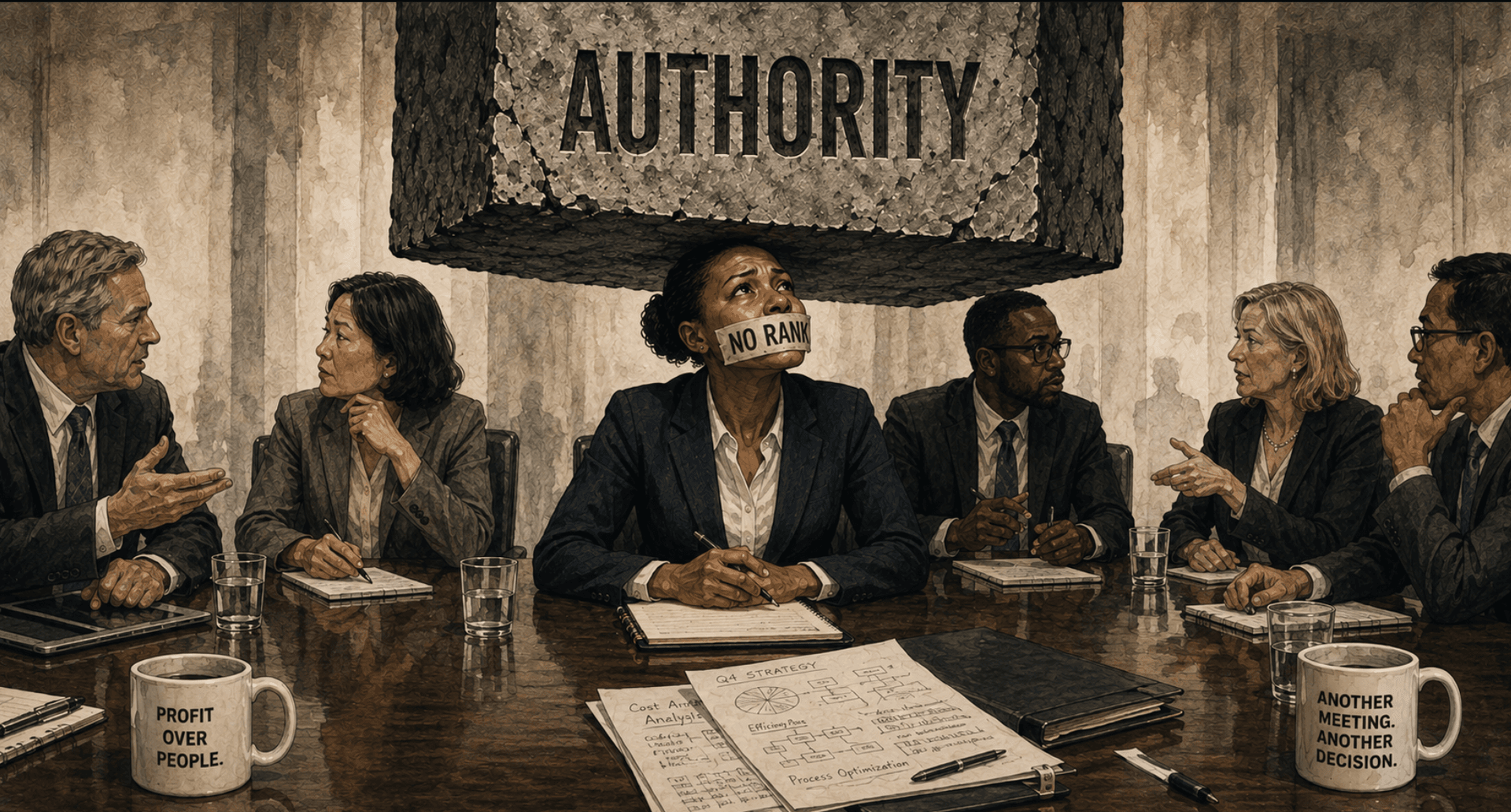
Boeing offers a modern warning.
In 2024, Boeing quality engineer Sam Salehpour testified before Congress that he had raised manufacturing and safety concerns and experienced retaliation. Boeing disputed important elements of his technical allegations.
The lesson isn't that the engineer must have been right.
It's more important than that:
Neither the engineer nor the executive should be right because of status. The evidence has to survive both.
The FAA's broader examination of Boeing's safety culture produced dozens of recommendations involving reporting, oversight, communication and safety management.
The issue wasn't simply whether people were allowed to speak.
It was whether the institution could hear.
What happens to truth on the way up?
Suppose an engineer identifies a defect.
To engineering:
Something may fail.
To operations:
Production may stop.
To finance:
Revenue may fall.
To leadership:
The strategy may be threatened.
The fact hasn't changed.
Its consequences have.
Call this epistemic conversion: the transformation that occurs when evidence moves through people with different responsibilities, incentives and exposure to its consequences.
Conversion is inevitable.
Distortion isn't.
The danger begins when:
“There is a problem”
becomes:
“This person is creating a problem.”
Now the institution is no longer interrogating the evidence.
It is interrogating the messenger.
We know how serious that can become.
Before the space shuttle Challenger launched in 1986, engineers raised concerns about its O-rings in unusually cold temperatures.
Management ultimately recommended proceeding.
Challenger disintegrated 73 seconds after liftoff.
Seven astronauts died.
The presidential commission found more than a technical failure. Critical engineering concerns had failed to reach senior decision-makers with their full significance.
Nearly four decades separate Challenger from Boeing's recent safety-culture scrutiny.
Our machines changed.
The vulnerability in the human system survived.
At sufficient scale, that vulnerability becomes more than a workplace problem.
A suppressed engineering warning can become a safety problem. An unchallenged model can become algorithmic discrimination. A financial risk nobody wants to escalate can become somebody else's economic crisis.
When an institution loses the ability to hear inconvenient reality, eventually the consequences leave the building.
We built it this way for a reason
Hierarchy wasn't a mistake.
It was one of civilization's great coordination technologies.
Large groups cannot renegotiate every decision. Someone eventually has to decide.
Industrialization made that principle enormously productive. Standardization reduced variation. Management increasingly designed systems that workers executed.
That architecture helped build the modern economy.
But a system designed to coordinate human labor gradually acquired authority over human judgment.
Psychology made it durable.
People calculate the consequences of disagreement. Inside organizations, those consequences can involve reputation, opportunity, compensation and advancement.
Silence can therefore be rational.
And silence creates more silence.
I see everyone else accepting the decision.
I assume they know something I don't.
I remain quiet.
Someone else interprets my silence as agreement.
Consensus can manufacture itself.
So stop asking:
“Are employees allowed to speak?”
Ask:
“What is the price of being right when someone more powerful is wrong?”
That tells you what an institution actually believes about truth.
Then Maya became the hierarchy
Years passed.
Maya became excellent at her job.
She learned the business. Her judgment improved. She was promoted.
Eventually a young employee entered her office and questioned an established process.
Maya immediately recognized what he didn't understand.
“There’s some context you're missing,” she told him.
Then she heard herself.
The system had reproduced itself.
Not because Maya became a bad leader.
Because she became an experienced one.
Institutions survive through good people who learn the rules of success and eventually teach those rules to someone else.
Maya decided she wouldn't become that manager.
So she tried something different.
She told her team:
“Challenge everything.”
For a while, it felt liberating.
Then meetings became longer.
Decisions that had already been settled reopened.
People challenged subjects they barely understood.
The most confident voices sometimes overwhelmed quieter people with greater expertise.
Maya had removed friction.
She had also removed clarity.
And she discovered the flaw in the standard debate over workplace autonomy.
Conformity suppresses intelligence. But removing structure does not automatically produce intelligence.
The problem wasn't hierarchy itself.
It was asking hierarchy to do too many things.
Four questions
One afternoon, Maya stood at a whiteboard and wrote:
What cannot change?
What result must we produce?
Who knows the most about this problem?
Who owns the final decision?
The answers were not always the same person.
That was the breakthrough.
Organizations had bundled four distinct things together:
Standards. Expertise. Decision rights. Status.
Maya began separating them.
Law, safety and ethical boundaries remained nonnegotiable.
Objectives remained clear.
Expertise could come from anywhere.
Decision ownership remained explicit.
A junior employee could possess the strongest technical argument without becoming the manager.
A manager could retain final accountability without pretending to possess the strongest technical argument.
Rank determines responsibility. Evidence determines credibility.
Now Maya began experimenting.
Before important meetings, people submitted their judgments before she revealed hers.
If someone challenged an established method, the response wasn't “stay in your lane.”
It was:
“Show me.”
Build the case.
Define the risk.
Run a bounded test.
Measure what happens.
And once a decision was made, the team moved.
Challenge before the decision.
Coordinate after it.
Maya's team didn't begin agreeing more.
They learned how to disagree better.
That was the result she hadn't expected.
Then AI changed the scale
This is why the argument matters now.
People have challenged authority for thousands of years.
What changed is the distribution of cognitive power.
For most of organizational history, knowledge accumulated slowly and disproportionately around experience, credentials and position.
The internet democratized information.
Artificial intelligence is beginning to democratize cognitive leverage.
A junior employee cannot download 25 years of judgment.
But they can analyze enormous datasets, interrogate research, model alternatives and test assumptions with capabilities unavailable to entire departments a generation ago.
The industrial corporation was designed around:
centralized intelligence directing distributed labor.
We are moving toward:
distributed human intelligence amplified by machine intelligence.
And here lies the great contradiction of the late 2020s:
We are building machines capable of challenging our assumptions inside institutions that may still punish humans for doing the same thing.
Companies can spend billions increasing the intelligence available to employees while maintaining hierarchies that determine when those employees are permitted to use it.
That isn't merely cultural dysfunction.
It is economic waste.
And at societal scale, it becomes something more dangerous.
AI could liberate truth. Or industrialize conformity.
Artificial intelligence does not automatically produce independent thought.
It can become another authority.
For generations:
What does the boss think?
The emerging equivalent could become:
What does the model say?
The authority changes.
The surrender remains.
That distinction matters because algorithms operate at scale.
A human manager's flawed assumption might distort one department.
A flawed automated system can influence hiring, credit, public information or markets across millions of decisions.
The danger of AI is not only that machines may become capable of thinking. It is that humans may become increasingly comfortable not doing so.
The institutions of the intelligence age therefore need something beyond artificial intelligence.
They need protected human judgment.
Maya builds the system she needed
Maya eventually gave her experiment a structure.
Call it The Agency Architecture.
Its premise was simple:
Agency is presumed. Constraints require reasons.
Safety.
Law.
Competence.
Risk.
Genuine interdependence.
Not:
because that's how we've always done it.
Important decisions began with independent judgment before authority entered the room.
Serious concerns had routes outside the immediate chain of command.
Expertise determined who led analysis.
Authority determined who carried accountability.
And Maya began measuring something she had never seen on a corporate dashboard:
epistemic health.
How quickly did bad news reach her?
How often did someone junior change a senior person's decision?
Were people raising problems earlier?
Did employees believe disagreement damaged their careers?
This wasn't about making people feel heard.
It was about making the organization harder to fool, including by itself.
Because:
If speaking truth requires unusual courage, the institution has already designed a fragile information system.
Power has an information tax
Years later, Maya entered another meeting.
Now she was the most senior person in the room.
She had a strong opinion about the decision ahead.
Earlier in her career, she would have explained it first.
Instead she asked everyone to independently submit their assessment.
The responses came back.
Several disagreed.
Two identified a risk she had missed.
Maya changed her position.
Nobody had suddenly become smarter.
She had changed the architecture through which their intelligence reached her.
Someone finally asked:
“So who makes the call?”
Maya answered:
“I do. That's my responsibility. Being responsible for the decision doesn't make me responsible for being right before we've examined the evidence.”
That is the distinction hierarchy has spent too long blurring.
Authority is responsibility.
It is not ownership of reality.
And authority carries a hidden cost:
The more power you acquire to make consequential decisions, the harder it can become to know what people actually think.
Power has an information tax.
Sophisticated leaders don't merely invite disagreement.
They build systems that protect themselves from the distortions created by their own authority.
What Maya learned on a small team is rapidly becoming a societal question.
We are distributing extraordinary cognitive power through artificial intelligence while retaining institutions built for a world in which intelligence was assumed to concentrate near the top.
The challenge ahead is not choosing between hierarchy and freedom.
It is learning how to distribute intelligence without losing coordination.
How to preserve expertise without worshipping credentials.
How to use machines without surrendering judgment to them.
How to give authority enough power to act without giving it the power to determine what is true.
For more than a century, corporations perfected how instructions travel downward.
The intelligence age demands the opposite achievement:
making truth powerful enough to travel upward.
Because the defining leader of the next era may not be the person with the best answers.
It may be the person who has built an institution capable of proving them wrong.